Web Assembly
Contents

I made a demo app using Go compiled to Web Assembly. Check it out the repo: game of life in go wasm
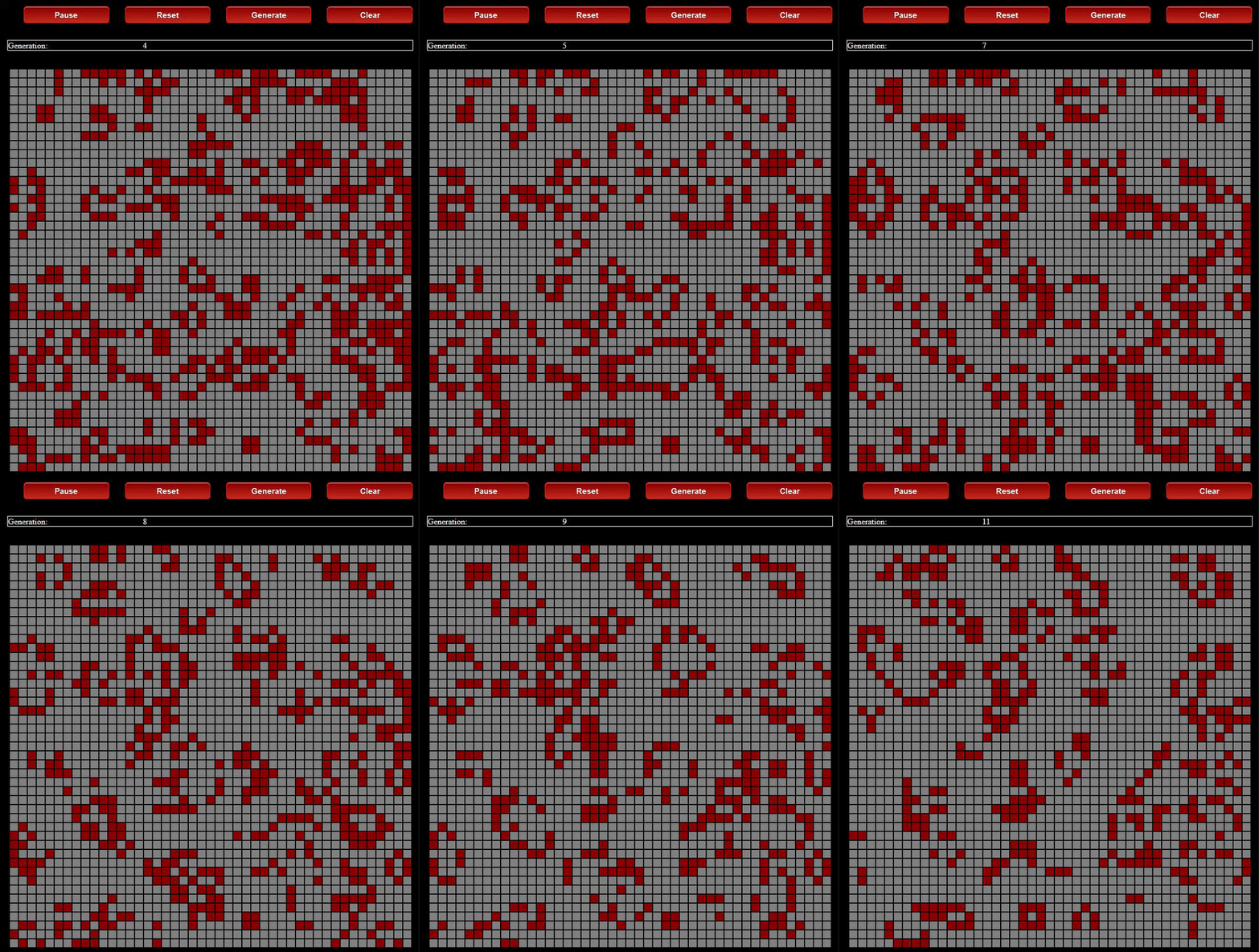
This stuff is exciting!
I'll go over some techincal details about the code first, but feel free to skip ahead to the High Level on Web Assembly section.
A Look at the code
life.go
I attempted to keep this file entirely unrelated to the DOM and Web Assembly. It's simply an implementation of game of life. I created an interface called a Renderer in hopes that I could eventually create multiple types of renderers (e.g. canvas, terminal, etc…)
The one implementation of Renderer is dom.go.
dom.go
This is where the secret sauce is. If you're only here to look at some code examples, this is probably where you should look. https://github.com/dfirebaugh/game-of-life-wasm/blob/master/wasm/dom/dom.go
This file makes heavy use of Go's syscall/js library. This is how we can manipulate the dom with Go.
wasm_exec.js
./client/wasm_util/wasm_exec.js is provided by Go and can usually be found at
\$(go env GOROOT)/misc/wasm/wasm_exec.js
This is kind of the glue code that helps your javascript communicate with Web Assembly modules written in Go.
It would be nice if this packaged as an npm module. This would allow me to install the "glue code" by simply typing npm install go-wasm-exec or something similar.
One of the challenges with this is that this file ships with Go and it's recommended to use the version of that file that corresponds with the Go version that you are using.
I wanted to leave this file unmodified because it was provided by Go.
You'll notice several helper functions that make translating between types in wasm and types in JS. Btw, the only types in web assembly are numbers. So, ints and floats… There are several functions being imported which are used by go's syscall/js package.
This file also handles loading the wasm file. If I decided not to use syscall/js package from Go, I could have ran this WebAssembly.intantiate() function myself and added my own imports. However, I wanted to try to keep things simple for this demo.
wasm_loader.js
To leave wasm_exec.js unmodified, I decided to import wasm_exec.js as an es module into a new file wasm_loader.js.
wasm_loader.js is a very small file that only loads the wasm file.
import './wasm_exec.js'

const go = new Go()
WebAssembly.instantiateStreaming(fetch('wasm.wasm'), go.importObject)
  .then(result => {
    go.run(result.instance)
  })
  .catch(console.error)
server.go
There's nothing special about server.go. It's simply a web server that serves up the client and serves up the wasm file.
Note that the wasm file is being served up with a specific MIME type.
resp.Header().Set("content-type", "application/wasm")Manipulating the DOM
Manipulating the DOM with Go actually seemed to be a step backwards. It felt similar to the jquery days. Or rather, it felt like managing the DOM with vanilla JS where you do some query selectors and imparatively make changes as needed. As a JS dev, this was fairly simple to pick up because you are calling the same APIs that javascript has access to.
I found that there were some obvious rendering improvements that I could have made by implementing some lazy rendering or diffing to reduce how many times I wrote to the DOM. For this demo, I felt OK with ignoring these improvements. However, that isn't something unique to web assembly. I can see how libraries could make this low effort for us in the future.
I much prefer the declarative nature of something like React/jsx or even standard HTML than having to manually to call createElement and similar methods. So, even though I did a lot of DOM manipulation with Go in this app, I can't say I recommend it.
Tools like wasm-bindgen make sharing memory/values pretty straight forward, but eventually it will be built into the spec.
Shared Memory
The WebAssembly.Memory object has a buffer property is a resizable ArrayBuffer that holds the raw bytes of memory accessed by a WebAssembly Instance. – MDN
In my demo, I'm not accessing this "memory" directly, but the go package that I'm using is definitely taking advantage of the shared memory buffer.
I would like to explore more with sharing values to JS so that I can use javascript or a library like react to manage the DOM.
syscall/js
syscall/js is a package with several functions that help share data between JS and Go. In my demo, I use it mostly for DOM manipulation. Maybe in my next project I'll explore more with functions such as CopyBytesToJS and CopyBytesToGo which seems to allow you to directly share values from Go to JS.
Lessons Learned and Gotchas
I cover this a bit later in Problems with Go
High Level on Web Assembly
What is Web Assembly?
WebAssembly (abbreviated Wasm) is a binary instruction format for a stack-based virtual machine. Wasm is designed as a portable target for compilation of high-level languages like C/C++/Rust, enabling deployment on the web for client and server applications – Web Assembly Home Page
The super high level description is that Web Assembly allows us to write code for the web with languages other than Javascript.
There's a bit more to it than that.
Javascript Engines(most notably V8 on Chrome and Spider Monkey on Firefox ) run on top of a virtual machine in the browser (check out the history lesson a bit further down). Web Assembly runs on top of this same virtual machine.
The name Web Assembly is a bit of a mislabel because It's not quite Web and it's not quite Assembly (it's a bytecode intended to run on a VM – assembly usually refers to opcodes compiled to something natively executable by machines). Yes, you can compile to target browsers, but there's actually a lot of potential for web assembly running outside the browser. (see further in this writing Web Assembly Outside of the Web - WASI)
Will it Replace Javascript?
No. Web Assembly is intended to run along side of Javascript. Allowing you to use Javascript for it's strengths (expressiveness, ease of use, manipulating DOM nodes) while gaining efficiencies of near native speeds and strong typing of other language (e.g. C, C++, Rust, etc…)
Why do you need to be aware of Web Assembly Today?
Web Assembly (or wasm for short) has paradigm shifting potential that will affect how the web works and how we write software. Even if you're not actively writing code for Web Assembly, frameworks will be taking advantage of web assembly to optimize for performance.
WASM is being created as an open standard by W3C WebAssembly Community.
WASM was first announced in 2015, and gained first class support from all major browsers in 2017. Web Assembly is out today and it's likely that some software (and WebApps) that you use are currently taking advantage of it.
See further use-cases
Efficient and Fast
WebAssembly code can be executed at near-native speed across different platforms by taking advantage of common hardware capabilities. – Mozilla Developer Wiki
It's often said that Web Assembly is fast. "Fast" is in reference to how fast it is compared to Javascript. These days Javascript is amazingly fast, but wasm aims to perform at near native speeds.
Safe
Web Assembly is built for safety. Being that it runs off of the same VM that javascript uses, it's sandboxed just as javascript is.
The wasm security model ensures that wasm modules can't escape the sandbox without going through appropriate APIs.
There are some measures in place to ensure memory safety. When instantiating a wasm module, a new Javascript object is created which is attached to the wasm instance. Internally, this memory object creates an Array Buffer (mentioned previously.) Because this is just a JS object, it's tracked by the JS garbage collector (even though it's contents are not).
Wasm modules are also isolated in memory unless explicitly included in the imported memory object.
Security White Papers on Web Assembly:
Also note that Web Assembly is disassemblable via tools provided by the Web Assembly team. see WABT
Some Context and a brief history lesson

The Speed of Javascript
These days, Javascript is blazing fast. However, this wasn't always the case.
Javascript was written in ten days. Well, the first Javascript Engine Prototype took 10 days. It wasn't built for speed. Speed came later when browsers started implementing JIT (Just In Time Compilation) compilers in efforts to increase performance.
With any language there are usually tradeoffs. Javascript has a lot of ease of use and expressiveness. This allows for developers to get up and going quickly with it and allows for rapid prototyping of web apps.
The first JIT compilers in major browsers were implemented in 2008. This allowed browsers to increase the speed of javascript code running on the web making js code almost 10 times faster.
Web Assembly runs on top of the same VMs that these JIT compilers run on and Web Assembly will make the web even faster.
A decent demonstration of Web Assembly's performance: youtube video - WebAssembly - To the browser and beyond! | performance.now() 2019
Programming Web Assembly With Rust
Programming Web Assembly with Rust is an excellent book that walks through several projects to help you learn Web Assembly. It starts out by introducing WAT (Web Assembly Text Format) and then later dives into writing Web Assembly with the Rust Programming language.
This is a great book if you like learning by doing and it happens to be a decent intro to Rust.
Alternatively, here is an open source free to read book Rust and Web Assembly (Disclaimer - I have not read the "Rust and Web Assembly" book aside from skimming through a few chapters)
WAT
WAT (Web Assembly Text Format) is what allows Web Assembly to be human readable. It's probably not recommended to write an entire app this way. However, it's good to know for the purposes of learning how Web Assembly works behind the scenes and can be a useful tool for debugging.
If you've ever programmed in LISP, wat might seem familiar because it uses S-Expression
example:
(module
  (type (;0;) (func (param i32 i32) (result i32)))
  (func (;0;) (type 0) (param i32 i32) (result i32)
    local.get 0
    local.get 1
    i32.add)
  (export "add" (func 0)))
Rust
Rust has been voted Stack Overflow's most loved language for four years in a row
At the moment, Rust is probably the best language for writing code for Web Assembly. Mostly that there's a lot of tooling and support. The Rust team is driving a lot of progress in the Web Assembly arena.
Again, most languages have trade offs. For Rust, it seems to be the difficult learning curve.
Rust seems to be the systems and embedded level programming language of the future.
Why Go?
I chose to do some experimenting with Web Assembly with Go for a few reasons.
- It's great for enterprise software
- I know it fairly well.
- Simple idiomatic opinionated syntax
- Interesting concurrency patterns
- Closures (not that other languages don't have closures)
Perhaps more importantly, we use it a lot at work and I was interested in evaluating how viable Go would be for writing Web Assembly modules.
Problems with Go
Go is intended for writing software (usually) on servers. One of Go's tradeoffs is that they didn't care a lot about how big the binaries compile to. Therefore, Go binaries are bigger (in comparison to Rust or C). This is because Go runtime is fairly large. Which is nice sometimes, because there are many built-ins in the standard libraries.
It seems that the Go team is actively working on solutions to provide better support for compiling to wasm.
TinyGo
TinyGo is a compiler for Go intended for use on microcontrollers. TinyGo now also supports compiling to Web Assembly. It's based on LLVM
Oh TinyGo, I had some hopes for you, but ultimately the most recent standard Go compiler had better support for Web Assembly out of the box.
However, the binaries were a lot smaller. The TinyGo binaries were only a few kilabytes. Whereas the Go binaries were around 2 to 3 megabytes. (note: 2 to 3 megabytes is fairly large to be shipping over http)
Concurrency?
With the breakdown of Moore's law, concurrency will become increasingly important. Transistors won't be getting exponentially smaller, but it's possible that we lean more on parallelism and concurrency models to increase performance in applications.
Some may say that Go's concurrency model is the entire point of Go. Go handles this with the interesting concepts (e.g. goroutines(which are "kind of" lightweight threads) and channels which are "kind of" similar to named pipes or FIFOs in linux)
So, can you do concurrency with Go in web assembly?
Yes, you can!
Web Assembly, the Future and Beyond
Web Assembly is an Intermediate Representation. It isn't targeting a specific machine. It's targeting virtual machines which know how to run on specific machines. So, we can run Web Assembly on many types of environments.
 (image by Lin Clark of code cartoons)
Web Assembly Outside of the Web - WASI
WASI is a modular system interface for WebAssembly. –wasi.dev
WASI allows you to run Web Assembly outside of the web on all different OSs.
… it provides a fast, scalable, secure way to run the same code across all machines. – standardizing wasi
The Future
- Being that Web Assembly is more efficient, this could lead to lower battery consumption on mobile devices.
- Small devices like chromebooks have increased useability.
- Javascript libraries will be taking advantage of performance gains by implementing Web Assembly modules behind the scenes
- WASM has a future in serverless cloudflare workers
- WASM will have a presence on the IOT space
- Web Assembly roadmap
Other Resources
Awesome Wasm is a github repo with lots of links to Web Assembly resources and Projects. Lin Clark(Mozilla) does some excellent talks on web assembly.